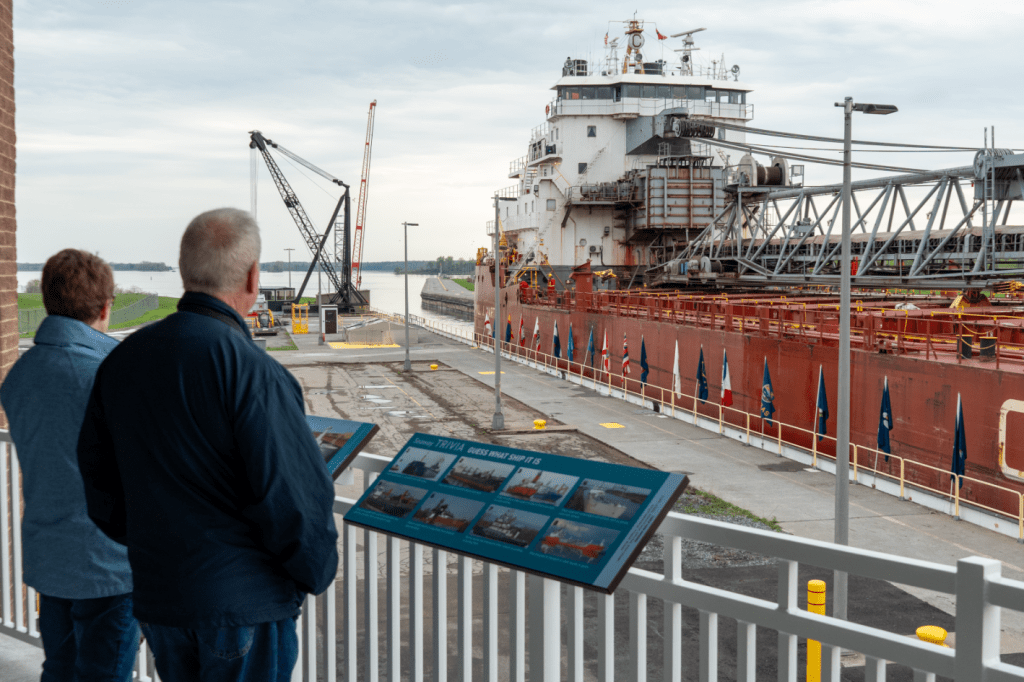

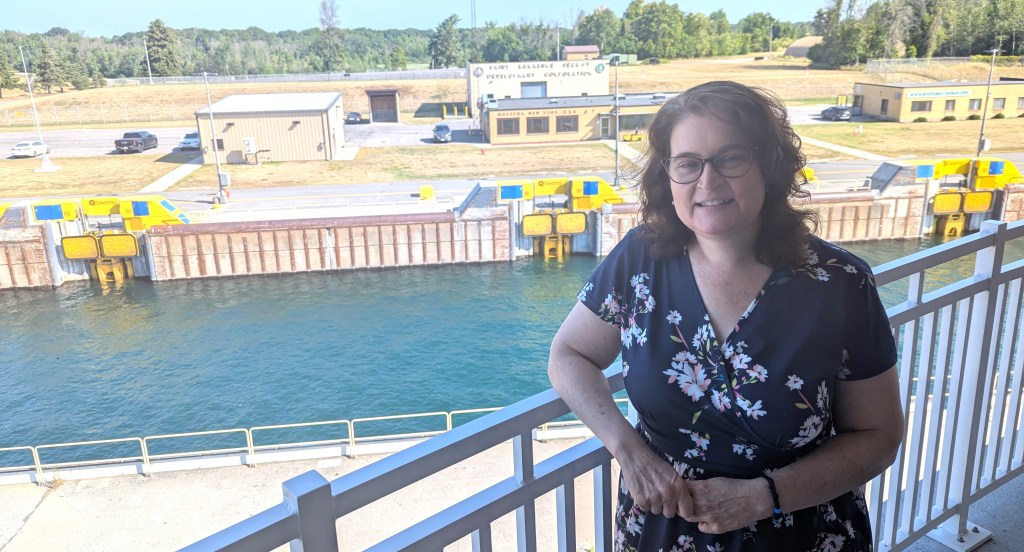
This was a trip I hadn’t made since sixth grade – I’m guessing 1968 – but the first sight was surprisingly familiar. Pulling up to the Eisenhower Lock outside Massena, I immediately noticed the highway passing under the shipping lane.
That tunnel near Barnhart Island hasn’t changed since the St. Lawrence Seaway opened on June 26, 1959. The visitor center, however, has moved from the Sputnik Era to the Digital Age, light years ahead of its predecessor.
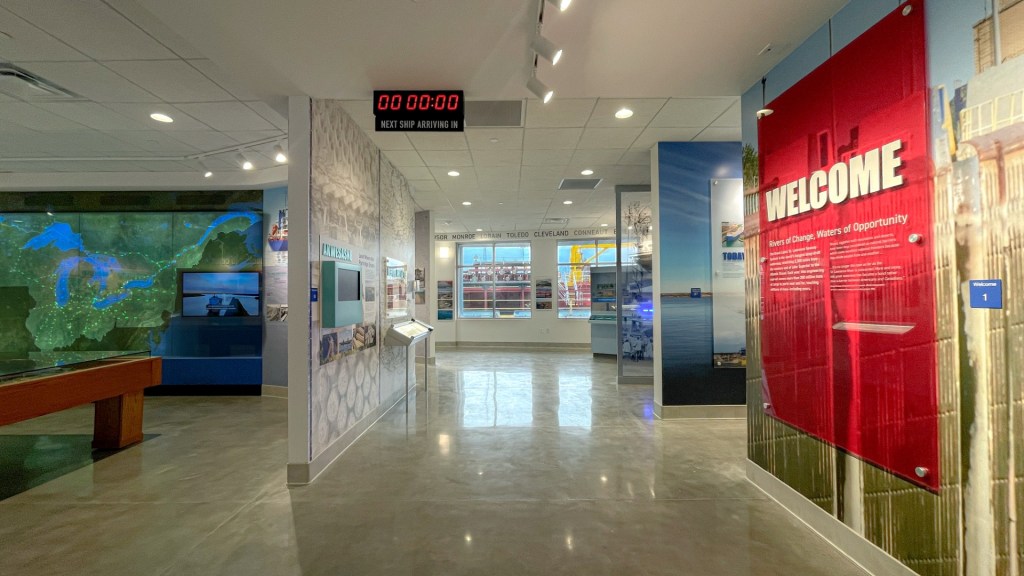
My boyhood recollection of a topographic map with a few blinking red lights has been replaced by a colorful, 3-D model the length of two picnic tables. It’s only one exhibit in the two-year-old jewel that is the Seaway Visitor Center, which was re-opened in May 2024. The three-story building perched alongside the lock – free to the public and only 50 miles from Ogdensburg – offers an interactive experience for tourists, school classes and history buffs.
“People sometimes overlook the Seaway because the ships and the St. Lawrence River have become such a constant presence in our lives,’’ said Amy Stark, community relations manager and director of the Seaway Visitor Center at Eisenhower Lock. “You don’t realize the economies within the Seaway system contribute to a GDP (gross domestic product) of $6 trillion.’’
That would make it the third largest economy in the world, trailing only the United States and China but ahead of Germany, India, Japan, the United Kingdom and France.
A visit to the Seaway Center engages tourists on a variety of levels:

Children: The exhibits invite them to actively participate. In video simulation booths, they can steer a vintage wooden craft down the Lachine Rapids near Montreal or guide a modern-day laker into a lock. Be precise. The concrete walls of the locks accommodate ships 740 long and 78 feet wide. That leaves one foot of clearance on either side. Or children might try their skill at balancing wooden blocks on a miniature ship deck, simulating the loading of a cargo ship.
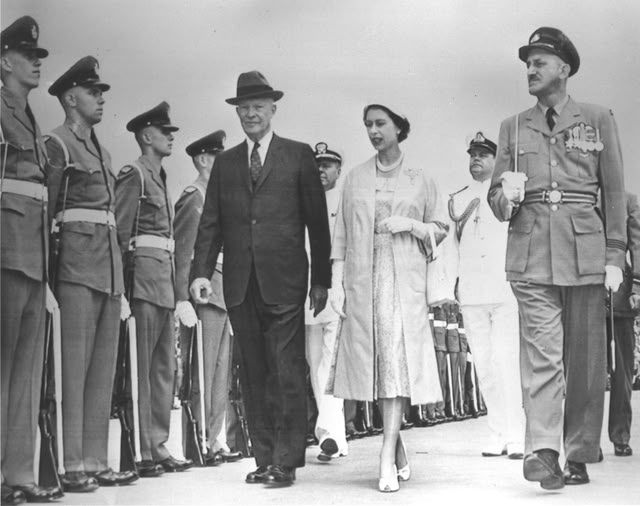
Adults: Old-timers like me connect with abundant historical information. You’ll read details of the May 1954 treaty with Canada to begin joint construction. You’ll see photographs of Queen Elizabeth and President Dwight D. Eisenhower at the dedication. Laborers are dwarfed by the size of earthmovers, construction equipment and concrete walls. The Lost Villages exhibit details how dams and locks forced the river to swell outward, submerging low-lying communities. A 20-seat theatre shows brief movies about aspects of the Seaway and its locks.
Efficiency: Great Lakes ships lower congestion on highways and cut greenhouse gas emissions. They can carry up to 30,000 tons of wood products, ore, grain or bulk goods, the equivalent of 963 trucks or 301 rail cars. The most striking cargoes that ship watchers have notice in recent decades are gigantic, white turbine blades headed for wind farms. They’ll be generating electricity without burning fossil fuels.
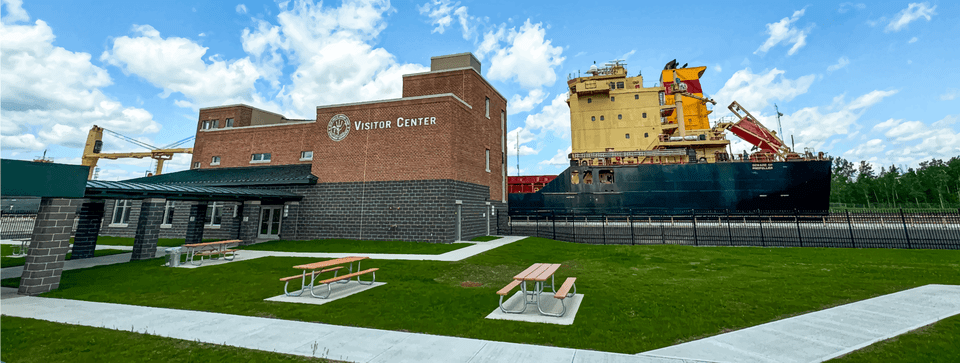
Lock operations: Exhibits explain the 552-foot drop from Lake Erie downbound to Montreal, including the Welland Canal locks near Niagara Falls and locks along the St. Lawrence. But nothing surpasses the spectacle of watching a salty or a laker pass through Eisenhower Lock from the observation decks. To make sure you don’t miss it, an overhead clock acts like a small scoreboard, displaying the countdown to the next ship’s arrival.
Children and adults always revel in watching the iron behemoths nestle between the walls. From the third-story observation deck, you’ll notice that steel cables (arresters) have been replaced by HFMs (hands-free mooring systems) using vacuum pads to stabilize ships while the water level is raised or lowered by 40 feet.
Stark observes more than 100,000 visitors passing through the Visitor Center each year. Tourism is heaviest in the summer; school groups dominate the spring.
It seems every family sent a father, brother or uncle to work on the construction crews. Stark has listened to stories about relatives digging locks or attending the opening festivities 66 years ago.
“Many visitors come in who were children at the time of the construction and they share about attending the ceremony, and about family land being lost during the construction,’’ she said.
“We had a married couple visiting and each had been at the ceremony as children – one was in the choir that performed when the queen was coming through and the other was in the scouts attending with his troop.’’
Stark recalled another notable, regular visitor.
“Dorothy was 19 in 1959 and served as a waitress for the queen’s luncheon that was held in Cornwall,’’ Stark said. “She still has the program with the menu from that event.’’
The Seaway continues to provide memories.
Morristown native Jim Holleran is a retired teacher and sports editor from Rochester. Reach him at jimholleran29@gmail.com or view past columns under “Reflections of River Rat’’ at https://hollerangetsitwrite.com/blog/
 Holleran Gets It Write