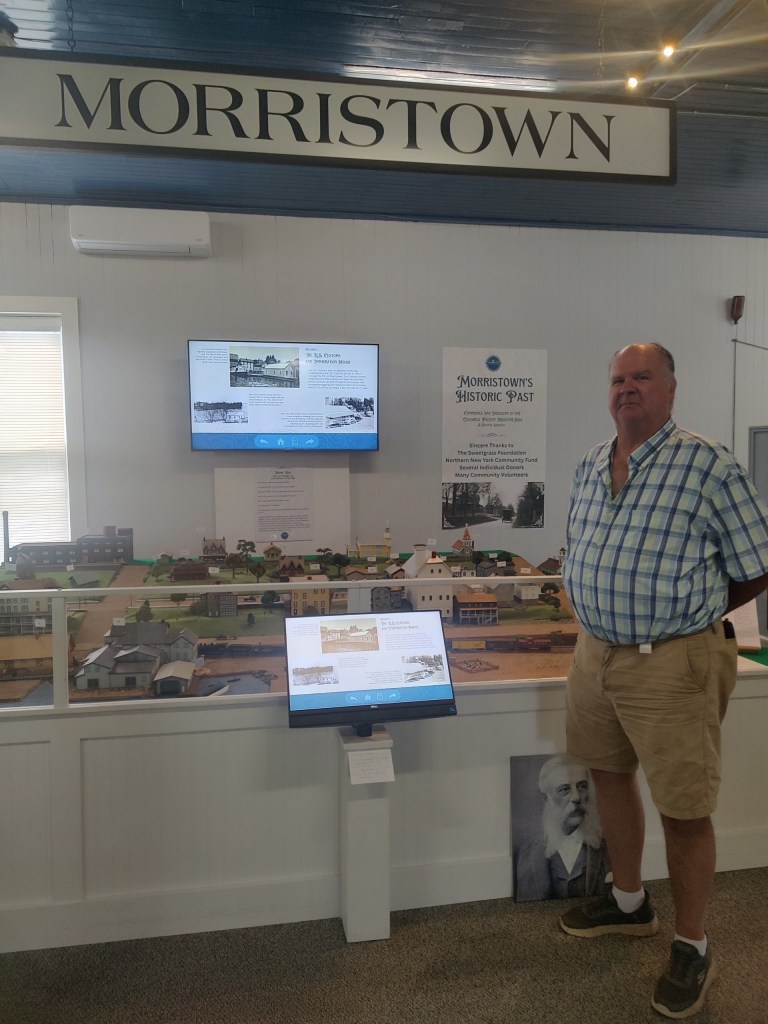

When you enter the Morristown Gateway Museum, the diorama depicting village life in the early 1900s will stun you. You’ll find homes and businesses recreated in precise detail. A marching band moves down Main Street. Railroad cars are poised along the waterfront as if they await the next shipment of Dr. Morse’s Indian Root Pills.
The master craftsman behind most of this interactive display is a lifelong town resident, Jeff Swift. Many know him as the building trades instructor at Northwest Technical Center in Ogdensburg who retired in 2017. Others recall him from the Gateway Museum board of directors. His classmates and teachers recall him as the 6-foot-5 starting center on the 1974 Green Rockets basketball team.
U “Jeff is central to the diorama project,’’ commented Gateway board member Chris Coffin. “Jeff moved the diorama forward, being flexible over the years about the size and layout of the miniature village as the Museum evolved with other exhibits. He also gave significant financial support when he saw that the project was moving forward.’’
Swift’s longevity, persistence and knowledge of his hometown have generated first-class models of buildings, businesses and homes, many that have stood for generations and others lost to fires or even abandonment.
“I was approached by Wayne Latham Sr. around 2007 and asked if I would be interested in making a model of my parents’ home (House of the Seven Gables),’’ recalled Swift, 70. “This is where my interest in the diorama began. Wayne had done a lot of work preparing the work base for the diorama, basically making a 3-D map of the village, including lot sizes, elevations, streets. It was his vision that led to what we have today.’’

The Gateway staff had recruited several residents to contribute miniatures, among them Jim Spilman (Spilman’s Fuel and Supply), Jim Postlethwhait (Comstock Social Hall), Don Potter Sr. (stone school house and Catholic and Methodist churches) and Jack Taylor (Methodist and Presbyterian churches), but Swift completed the lion’s share, at least 20 buildings.
“The goal, Wayne explained to me, was they wanted to depict the village around the time frame of 1900-1920 with the Fourth of July parade as a central point of interest,’’ Swift said.
When he started the miniature of his boyhood home on Gouverneur Street, memories of his youth flashed through his brain.
He was recalling baseball games in the backyard, breaking windows on the bus garage behind his home, playing army with the neighborhood guys in the nearby woods, ice skating, riding sleds and delivering newspapers.
But the memory that leaves him scratching his head occurred in his 30s when he was repairing the chimneys on the steeply pitched roof of Robert and Clara Swift’s home, where they raised six children. Swift had earned a forestry degree from Paul Smith’s College but opted for local construction jobs over heading to Western states.
“I look back on how we did the work and carried (concrete slabs) up the slope on roof brackets and put them in place. My youngest brother and I carried those 300-pound slabs up and lifted them in place without getting killed. Today, with the lifts and other safety equipment, the job would have been a lot easier, and safer.’’
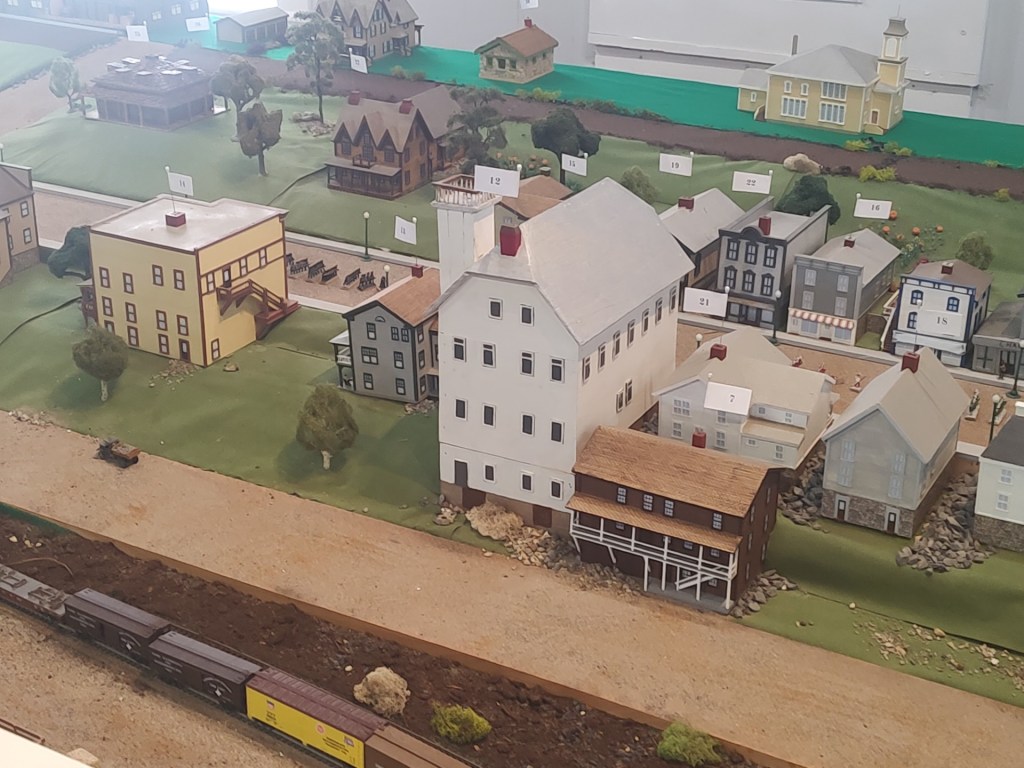
The miniatures he developed in his workshop require painstaking precision and attention to detail. He used a computer-assisted drawing program and gleaned information from pictures, postcards and tax maps. He converted measurements to HO scale (1:87 – 3.5 millimeters equals 1 foot). His buildings contained cedar shake roofs and clapboard sidings. Then he painted, using pictures or residents’ recollections to replicate the colors. The work could become tedious. He figured he spent more than 180 hours working on the replica of the Comstock Hotel.
When the diorama was installed at the museum, questions flowed from visitors. Board member Annemarie FitzRandolph secured a grant so that all the buildings would be flagged and a touchscreen would provide history snippets.
Swift and his wife of 49 years, Dot, will spend the winter tinkering in their home shop. Jeff wants to pursue wood turning; Dot is an artist. They have two daughters and four granddaughters to track. But he remains grateful for his life in the village.
“It is apparent to myself that I have the disease many people have in this area – it is the St. Lawrence River. This community has been important in my life and I’m glad I was born, raised and successful in it. It has been my reward to have been involved in preserving this snapshot of the village, and to have a place to share it with everyone today.’’
Morristown native Jim Holleran is a retired teacher and sports editor from Rochester. Reach him at jimholleran29@gmail.com or view past columns under “Reflections of River Rat’’ at https://hollerangetsitwrite.com/blog/
 Holleran Gets It Write