

Watch parties are set. Food is ordered. Schools and businesses will close. Hotel rooms are scarce. Everything seems ready for the once-in-a lifetime total solar eclipse on April 8.
But the biggest player in this whole celestial extravaganza – when the moon passes between the Sun and Earth and its shadow races across North America – remains an unknown. Will the clouds cooperate and permit a clear view?
Kris Hudson, a meteorologist with Watertown’s WWNY-TV, said an accurate prediction on cloud cover falls just outside of long-range weather forecast models, but there is a possibility that cloudy conditions will persist.

“Statistically, there is a 70-80 percent chance of cloud cover that day,’’ Hudson said, looking at historical trends. “But it remains too early to know.’’
That’s when he tossed out the silver lining.
“I can tell you that the last three years on April 8 we have had sunshine.’’
“Even if it is cloudy, you’ll be able to see the change to darkness, but you just won’t see the progression of the eclipse. It might not be the best viewing. It’s one of those things that can change quickly.’’
Here’s a primer on the eclipse:
THE FUNDAMENTALS
The lunar shadow crosses the Texas border at 2:27:21 p.m. EDT, races at about 2,300 mph on a Northeast path through 15 states across cities such as Cincinnati, Cleveland, Buffalo and Rochester, then exits Maine for the Atlantic Ocean at 3:35 p.m. Skies will darken as if it is dusk or dawn.
Ogdensburg’s location means the partial eclipse begins at 2:11:18 p.m. Totality is achieved at 3:23:49 and lasts 2 minutes, 37 seconds. But 18 miles away in Canton the totality lasts 3 minutes, 13 seconds. The most direct path of the eclipse, and greatest length of totality, will be centered over Route 3 across the southern end of the county.
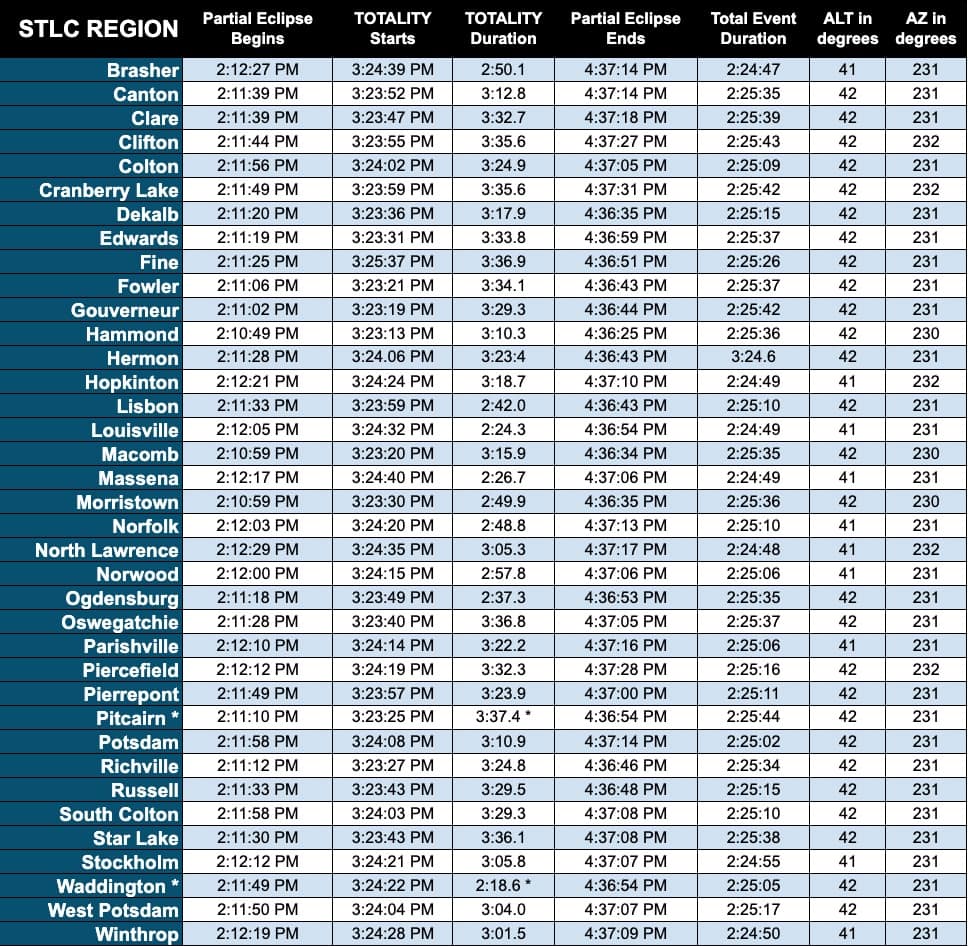
St. Lawrence County has posted a definitive timetable for each village and town, along with a detailed map, at
www.visitstlc.com/stlc-totality-viewing-timetable-2024/
PUBLIC SERVICES
Matt Denner, the county’s director of emergency services and fire coordinator, has been planning for more than a year, talking with town officials and consulting with emergency services managers where eclipses have occurred. He and his colleagues have developed and posted a master plan on the county website. They have considered jammed roadways, and burdens on restaurants, convenience stores, gas stations and emergency-care clinics, even ship traffic on the Seaway.
Spectators at the 2017 total eclipse in the Midwest tell horror stories of visitors traipsing across their property, failed cell service, and traffic jams as thousands hit the road in unison to return home.
“There is a hope,’’ Denner said, “that everyone does this safely and enjoys the view.’’
Denner is confident of services in larger towns, but traffic and cellphone service could be issues amid a possible influx of 50,000 visitors. The Route 3 corridor could be the biggest trouble spot, Denner said, because only two gas stations with restrooms exist around Star Lake and Sevey’s Point.
AAA warns of motorists trying to watch or take pictures from moving cars. It said drivers should remove eclipses glasses, watch for distracted pedestrians, and keep an eye out for animals confused by the darkness.

GLASSES
Your retinas could suffer serious damage if you view the partial eclipse without wearing specialized glasses. Black polymers or silvery mylar in the lenses block 100 percent of the harmful ultraviolet rays. You can safely observe the approximate 3 ½ minutes of the total eclipse without sun protection, but must wear the glasses during the partial eclipses.
HIGH PEAKS
Eclipse experts say the Adirondack Mountains offer a wonderful panoramic view of the shadow, but it’s not prudent to scale a mountain at this time because of mud, icy patches and runoffs.

Bill Merna, retired OFA basketball coach and veteran hiker, advised against it.
“One problem is coming down,’’ he said. “Your boots get a layer of Adirondack mud on them, making stepping on a rock a slippery, maybe dangerous, situation. Also, the trail often is a stream in the spring so hikers get off the trail, causing the trail to get wider and increase erosion.’’
The elevation exacerbates weather conditions too.
“The conditions on top are always much colder and more windy,’’ Merna said, “so unprepared hikers could get in trouble because of that.’’
If you insist on climbing, follow the safety protocols for hydration, illumination, navigation, insulation and sun protection.
THE EXPERT
Elaine Fortin of Potsdam is part of a network of Solar System Ambassadors sponsored by NASA. She balks at the “expert’’ title, but she has completed a several astronomy classes and worked at Harvard’s Smithsonian Center for Astrophysics.

She has given a series of presentations at libraries, including Ogdensburg, Potsdam and Watertown, and crossed the border to present in her hometown of Cornwall.
“Folks in New York are very aware of the eclipse,’’ she said. “In Cornwall, Ontario, people are just now hearing there’s an eclipse and are packing my presentations. The first got fully booked in three days and the second was capped in a week.’’
“Canadians are at risk of eye damage because they haven’t got the info they need.’’
She said eclipse glasses don’t seem to be as plentiful in Canada as towns such as Canton or Potsdam. Part of that phenomenon might be as you move 10 miles north of the St. Lawrence River, the total eclipse time wanes to as little as 30 seconds.
SCHOOL DAZE
Many schools will be using unused “snow days’’ from a mild winter to avoid conflicts with the eclipse buzz, reported Tom Burns, district superintendent at St. Lawrence-Lewis BOCES.

“There are logistical and safety concerns with holding sessions that day,’’ Burns said, “due to the darkness and increased travel we are expecting from visitors flocking to the North Country to view the eclipse within the path of totality.’’
His staff compiled a spreadsheet among member schools. He expected Brasher Falls, Canton, Clifton-Fine, Colton-Pierrepont, Gouverneur, Harrisville, Heuvelton, Lisbon, Massena, Norwood-Norfolk, Parishville-Hopkinton, and Potsdam to use unused snow days. Hammond and Hermon-Dekalb would be in session with a late arrival and dismissal for eclipse viewing. Edwards-Knox, Madrid-Waddington, Morristown and Ogdensburg are expected to dismiss early that day. Check with your local district for an exact plan.
FREQUENCY
The last total eclipse over St. Lawrence County occurred in 1569, and a partial eclipse will occur over Tupper Lake and areas to the south in 2205.
If you miss the total eclipse over Ogdensburg, don’t worry. You’ll get another chance in 2399.
Morristown native Jim Holleran is a retired teacher and sports editor from Rochester. Reach him at jimholleran29@gmail.com or view past columns under “Reflections of River Rat’’ at https://hollerangetsitwrite.com/blog/
 Holleran Gets It Write