
You can call the total solar eclipse throughout St. Lawrence County on April 8 the event of a lifetime, and you’d still be selling it short.
Event of a century? Keep going. These celestial events are so rare that your grandchildren’s grandchildren won’t be around to watch. Still, I’m not doing the eclipse justice.
Our regional solar system expert, Elaine Fortin of Potsdam, said the last time a total solar eclipse occurred over St. Lawrence County was 1569, and it covered the entire county. The next total eclipse will be in 2205 over Tupper Lake and areas south of it, but residents from Ogdensburg to Potsdam will observe only a partial eclipse. The next total eclipse over Ogdensburg will be in 2399.
Eclipses happen about every 18 months, but usually over water. A total solar eclipse is so rare – happening in the same Earth position on average every 360-410 years — that the chance to witness near darkness in midafternoon will be humbling. That’s why scientists such as Fortin, who was scheduled to speak Tuesday evening at the Potsdam Public Library, are so enamored by the shadow dancing in less than 70 days.
“It will be like a science-fiction movie,’’ she said. “The shadow is 110 miles wide and it is breathtaking. I’ve heard it’s an ethereal experience that you’ll never forget.’’

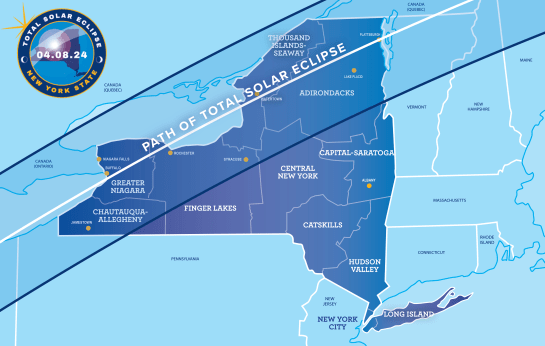
The path of the eclipse, formed when the moon passes between the Sun and the Earth, casting a shadow across Earth, initially will reach the United States in Texas, then continue northeast until it offers Buffalo a partial eclipse around 2:05 p.m. and a full eclipse by 3:18, which will last for about 3 minutes, 45 seconds. Rochester receives the full treatment about 2 minutes later as the moon’s shadow races at 2,288 mph.
Watertown’s partial eclipse begins at 2:10 p.m. with the full eclipse lasting about 3 ½ minutes, from 3:22:33 p.m. until 3:26:12 p.m. Lake Placid’s event will follow about 3 minutes later, then the shadow moves through Vermont, Quebec and out to the Atlantic Ocean.
Fortin speaks about eclipses as a Solar System Ambassador, a network of highly educated volunteers sponsored by NASA. She completed several astronomy courses and worked at the Harvard Smithsonian Center for Astrophysics before moving recently to Potsdam, where her husband once taught at Clarkson University.

“It’s like a superfast sunset,’’ Fortin said “Things get quiet. The rustling of the trees will get lower because the wind dies down. The temperature drops about 10 degrees because the sun’s rays are not warming the air. The birds will start chirping like it’s dawn. You might hear crickets chirping.’’
The most crucial piece of the entire viewing will hinge on the weather. Fortin is hoping for a cloudless sky so observers witness the full effect of the sky darkening in the west, then becoming “heavy dusk’’ overhead for about 3 1/2 minutes with only the sun’s corona visible. As the sun’s rays slip past the edge of the moon, the “diamond ring’’ effect will become observable and eventually the entire sun will reemerge.
Fortin said under the right conditions “you might see some stars or planets, but the most fascinating thing will be the corona, a huge halo of actual material from the sun.’’ The sun will have reached the peak of its 11-year cycle whereby its plasma might shoot outward to a distance that is three times its width.
To observe the sun’s disappearing act, you’ll need to take precautions.
“During totality you can look, but during the partial eclipse conditions you are risking your eyes,’’ Fortin reminded.

Solar eclipse glasses block all ultraviolet rays from direct sunlight and much of the visible light, allowing you to look safely. Without them, UV rays would be absorbed directly into your retinas and eventually destroy the tissues and cause serious damage. Looking through telescopes or binoculars only concentrates the rays and hastens the process.
Heavenly matters aren’t the only concerns. The North Country will have to deal with an influx of visitors akin to the chaos that gripped Midwestern states during the 2017 total eclipse. Tourists flocked to that totality zone, jamming traffic, inundating campgrounds and hotels, overwhelming digital networks and flooding gas stations and convenience stores.
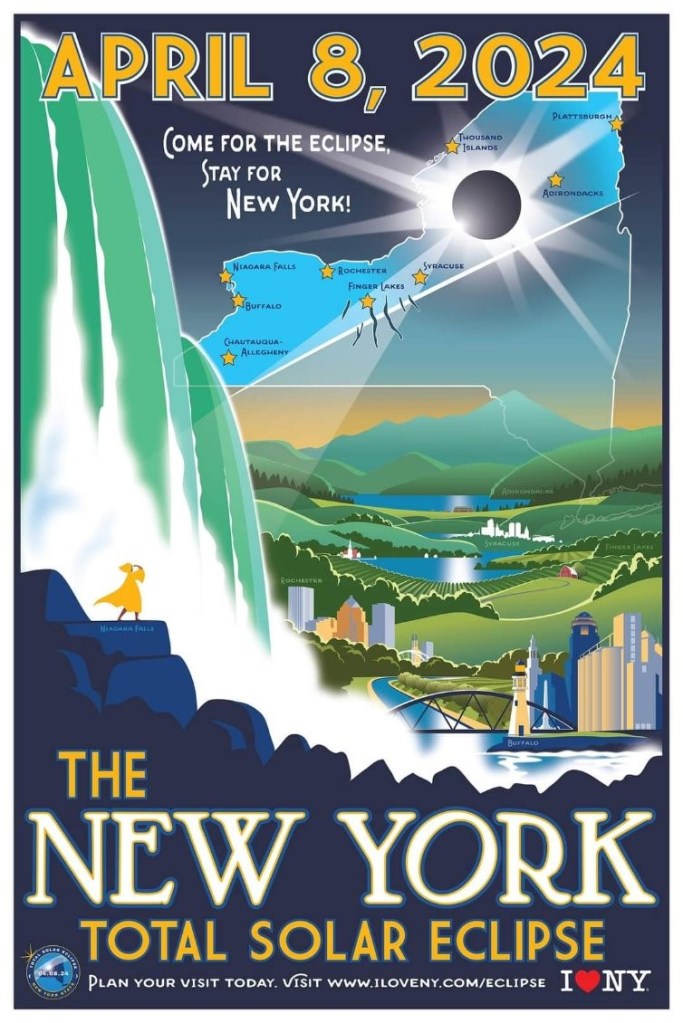
This will be a much grander scale than a smalltown fireworks show on a summer evening. Fortin said Tupper Lake (population 3,282), home to the Adirondack Sky Center and Observatory, expects to draw 5,000-8,000 visitors to its eclipse festival, Totality in Tupper.
The festival, on Sunday and Monday, includes activities like making box viewers and measuring solar energy, along with two nights of fireworks. Organizers will erect an 18-foot screen to telecast NASA’s livestream as the eclipse passes from Kerrville, Texas, through the Midwest, and onward to Tupper Lake.
You can search for more information about eclipse events in New York State at https://www.iloveny.com/events/eclipse-2024/ or from NASA at https://science.nasa.gov/eclipses/events/.
Morristown native Jim Holleran is a retired teacher and sports editor from Rochester. Reach him at jimholleran29@gmail.com or view past columns under “Reflections of River Rat’’ at https://hollerangetsitwrite.com/blog/
 Holleran Gets It Write